Showing posts with label New England. Show all posts

Tuesday, April 23, 2013

Financial Crisis & Haslett's Union Atlantic


Now that I've posted about bond traders and Tom Wolfe's The Bonfire of the Vanities, how about some finance fiction for the 21st century?

Here's last week's Wall Street Journal article, "EU Approves Bonus Caps for Bankers":"
The European Parliament passed new rules Tuesday that will cap bankers' bonuses and boost banks' capital buffers, clearing the last hurdle for the legislation to come into force next year. The rules will limit bankers' bonuses to 100% of annual salary, or twice the annual salary if shareholders explicitly approve.
The compromise deal, which was approved by a majority vote, was hammered out earlier this month between European lawmakers and member states in the face of opposition from the U.K., home to Europe's largest financial hub. Britain has warned that banks could move their operations to the U.S. or Asia, as a result of the new rules.
"The rules will put an end to the culture of excessive bonuses, which encouraged risk-taking for short-term gains," said José Manuel Barroso, president of the European Commission, the EU's executive arm. "If taxpayers are being asked to pick up the bill after the financial crisis, banks must also make a contribution."

For a novel about the financial crisis, try Union Atlantic by Pulitzer Prize finalist Adam Haslett:
In Haslett's excellent first novel (following Pulitzer and National Book Award finalist short story collection You Are Not a Stranger Here), a titan of the banking industry does battle with a surprisingly formidable opponent: a retired history teacher. Doug Fanning has built Union Atlantic from a mid-size Boston bank to an international powerhouse and rewards himself by building a rural palace in Finden, Mass. The land his house is built on, however, had been donated to Finden for preservation by Charlotte Graves's grandfather, and Charlotte believes she now has a claim on the lot. She may be right, and her disdain of modern decadence means bad news for Doug should she win in court.... This book should be of interest to readers fascinated but perplexed by the current financial crisis, as it is able to navigate the oubliette of Wall Street trading to create searing and intimate drama.

Tuesday, March 26, 2013

Alcoholism & Leary's The Good House


It seems that Las Vegas literature doesn't always focus on the feel-good aspects of the city: a post from earlier today discussed one novel about copious use of drugs and another about teen prostitution, and now it's time to talk about alcoholism in Glitter Gulch literature.

First off, the news. Here's last week's Huffington Post article "Alcoholism Rates Could Plummet With Higher College Enrollment, Penn State Researchers Find:"
The dark joke says that alcoholism only starts after college, but new research suggests that those who don’t enroll at all have a higher risk of developing a drinking problem. Despite all the binge day-drinking, beer funnels and massive parties, researchers from Pennsylvania State University -- a school that does its share of all of the above -- found that survey participants who attended college eventually developed a more responsible relationship with alcohol. The effect was heightened among students from low-income backgrounds, and the opposite was also true -- adults who did not enroll were six times more likely to develop a drinking problem by age 33. 
For a novel about alcoholism, you might like Ann Leary's recently released The Good House:
Hildy Good is a townie. A lifelong resident of an historic community on the rocky coast of Boston’s North Shore, she knows pretty much everything about everyone... Hildy is good at lots of things. A successful real-estate broker, mother and grandmother, her days are full. But her nights have become lonely ever since her daughters, convinced their mother was drinking too much, staged an intervention and sent her off to rehab. Now she’s in recovery—more or less.  
Alone and feeling unjustly persecuted, Hildy needs a friend. She finds one in Rebecca McCallister, a beautiful young mother and one of the town’s wealthy newcomers... When Frank Getchell, an eccentric local who shares a complicated history with Hildy, tries to warn her away from Rebecca, Hildy attempts to protect her friend from a potential scandal. Soon, however, Hildy is busy trying to cover her own tracks and protect her reputation. When a cluster of secrets become dangerously entwined, the reckless behavior of one threatens to expose the other, and this darkly comic novel takes a chilling turn.
I was not a fan of Leaving Las Vegas by John O'Brien.  Why not?  Well, here's Leary's opening:
I can walk through a house once and know more about its occupants than a psychiatrist could after a year of sessions.
That intrigues me:  I want to know more.  And it's clearly presented.

In contrast, here's a passage from O'Brien's novel describing his prostitute protagonist:
And she is a good thing, good at this thing.  Paying for and using her, there are always men available.  The tricks turn to her, for she glistens with the appealing inaccessibility of the always introspective.
Sentence one: cheap wordplay, playing cheaply with words.  Sentence two:  there's no noun for the verbs to refer to.  Maybe it's just me, but I think something like the following would sound better: "Paying for and using her, the men are always available."  Sentence three:  this part isn't too bad, but it still sounds a little cheesy, cliched, and overworked.  If you're still interested, here's a summary of the novel:
Leaving Las Vegas, the first novel by John O'Brien, is a disturbing and emotionally wrenching story of a woman who embraces life and a man who rejects it, a powerful tale of hard luck and hard drinking and a relationship of tenderness and destruction. An avowed alcoholic, Ben drinks away his family, friends, and, finally, his job. With deliberate resolve, he burns the remnants of his life and heads for Las Vegas to end it all in the last great binge of his hopeless life. 
On the Strip, he picks up Sera, a prostitute, in what might have become another excess in his self-destructive jag. Instead, their chance meeting becomes a respite on the road to oblivion as they form a bond that is as mysterious as it is immutable. Leaving Las Vegas tells a powerful story of unconditional love between two disenfranchised souls who connect for a fleeting moment.

Monday, March 25, 2013

Medical School & Shem's House of God


I've previously posted about the difficulties of caregiving.  How about the difficulties of being a doctor -- or even just training to be one?

From today's Boston Globe article "Empathy gap in medical students:"
Flint Wang was eager to start his third year of medical school, when he would finally break free of the classroom and treat patients. But once in the hospital, Wang, like many classmates, felt insecure and discouraged. Doctors don’t hesitate to point out students’ knowledge gaps. And neither do some patients. Medical training can be so stressful that it is sometimes difficult to connect with those being treated. “Your knowledge is shaky and you walk around the wards frazzled,’’ said Wang, 25, who nonetheless is glad he decided to become a doctor. 
The third year of medical school can be particularly bruising. But growing research suggests that something about this formative but punishing experience may harden students toward patients — a transformation that could persist years down the road. At Boston University School of Medicine, where Wang is now in his fourth year, Dr. Daniel Chen has found in studies that students’ empathy scores fell between the time they started medical school and the time they graduated. The most significant drop occurred in the third year, just as students started caring for their first patients.
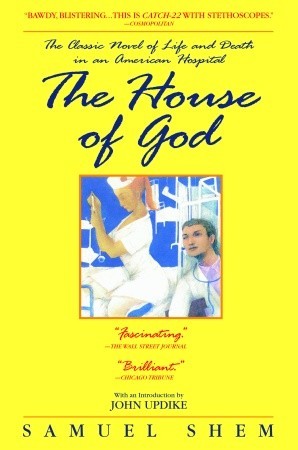
For a novel about medical school, try The House of God by Samuel Shem:
The hilarious novel of the healing arts that reveals everything your doctor never wanted you to know. Six eager interns -- they saw themselves as modern saviors-to-be. They came from the top of their medical school class to the bottom of the hospital staff to serve a year in the time-honored tradition, racing to answer the flash of on-duty call lights and nubile nurses. But only the Fat Man --the Clam, all-knowing resident -- could sustain them in their struggle to survive, to stay sane, to love-and even to be doctors when their harrowing year was done.
And according to the 2009 NYT article "A Book Doctors Can’t Close," the book is still frequently read among the medical community:
It was a raunchy, troubling and hilarious novel that turned into a cult phenomenon devoured by a legion of medical students, interns, residents and doctors. It introduced characters like “Fat Man” — the all-knowing but crude senior resident — and medical slang like Gomer, for Get Out of My Emergency Room. Called “The House of God,” the book was drawn from real life, and 30 years after its initial publication, it is still part of the medical conversation. Written by a psychiatrist, Stephen Bergman, under the pseudonym Samuel Shem, M.D., the novel is based on his grueling, often dehumanizing experiences as an intern at Harvard Medical School’s Beth Israel Hospital in 1974... 
What makes “The House of God” singularly compelling is its brutally honest portrayal of the absurd tragedies and occasional triumphs of hospital life; the once-common abuse of young physicians by their superiors; and the anger and frustration these interns directed at themselves and patients. The novel introduced many derogatory terms to the medical culture. Gomer referred to the elderly, chronically ill patients no intern wants to deal with. The shorthand LOL in NAD (Little Old Lady in No Apparent Distress), was for patients needlessly admitted by their private physicians for expensive work-ups...

Sunday, March 24, 2013

University Scandals & Tartt's The Secret History


So this one's a bit of a stretch, but it involves a great article and an even better book, so I'm okay with that.

I've previously posted about shenanigans on university faculty boards.  Now here are some shenanigans by the students themselves.  Here's this week's Guardian article "Harvard sees NCAA basketball win overshadowed by quiz team scandal:"
Academic disgrace and sporting glory are unfamiliar terms at Harvard. But on Friday, the university found itself experiencing both. Just as the Crimson were celebrating a surprise victory over New Mexico in the NCAA basketball tournament, news came that the school had been stripped of four national quiz tournament titles. National Academic Quiz Tournaments (NAQT) announced that a member of Harvard's quiz bowl team, which competes in intercollegiate trivia competition, had improperly accessed questions used in its tournaments from 2009 to 2011. The Harvard student, Andrew Watkins, had access to the NAQT administrative website as a writer of questions to be used in primary, middle and high school competitions. He is alleged to have seen the first 40 characters of questions presented to Harvard in tournaments they won several years in a row.
Want a novel about university lies, secrets, cover-ups, and immorality? How about -- stay with me on this one -- Donna Tartt's The Secret History:
Under the influence of their charismatic classics professor, a group of clever, eccentric misfits at an elite New England college discover a way of thinking and living that is a world away from the humdrum existence of their contemporaries. But when they go beyond the boundaries of normal morality their lives are changed profoundly and forever, and they discover how hard it can be to truly live and how easy it is to kill.

Wednesday, March 13, 2013

Smallpox & Carrell's The Speckled Monster


From today's front page New York Times article "Wary of Attack With Smallpox, U.S. Buys Up a Costly Drug:"
The United States government is buying enough of a new smallpox medicine to treat two million people in the event of a bioterrorism attack, and took delivery of the first shipment of it last week. But the purchase has set off a debate about the lucrative contract, with some experts saying the government is buying too much of the drug at too high a price... Smallpox was eradicated by 1980, and the only known remaining virus is in government laboratories in the United States and Russia. But there have long been rumors of renegade stocks that could be sprayed in airports or sports stadiums. Experts say the virus could also be re-engineered into existence in a sophisticated genetics lab.

I don't know about you, but I don't have much idea of what smallpox is like. It appears we are in luck, however, because Jennifer Lee Carrell's semi-novel The Speckled Monster puts us right in the middle of an outbreak:
The Speckled Monster tells the dramatic story of two parents who dared to fight back against smallpox. After barely surviving the agony of smallpox themselves, they flouted eighteenth-century medicine by borrowing folk knowledge from African slaves and Eastern women in frantic bids to protect their children. From their heroic struggles stems the modern science of immunology as well as the vaccinations that remain our only hope should the disease ever be unleashed again. Jennifer Lee Carrell transports readers back to the early eighteenth century to tell the tales of Lady Mary Wortley Montagu and Dr. Zabdiel Boylston, two iconoclastic figures who helped save London and Boston from the deadliest disease mankind has known.

Friday, March 1, 2013

Pedophile Priest Scandals & Haigh's Faith


Since the papal conclave has been in the news recently, there have been a few article highlighting the Catholic church's ongoing sex abuse scandal.  For example, here is yesterday's Guardian article "Catholic church sex abuse ruling could cause big spike in compensation claims:"
The Catholic church could facing spiralling compensation costs after an attempt to avoid liability for abuses committed by priests and nuns was dismissed by the UK supreme court.... Lawyers for the trustees of Portsmouth Roman Catholic Diocesan Trust had appealed against a decision in the court of appeal that they had a duty to compensate a young girl for alleged beatings inflicted by a nun and sexual abuse perpetrated by a priest as long ago as the 1970s... The claim was brought by a 48-year-old woman known as JGE, who cannot be named for legal reasons. She said that as a child she was beaten by a nun at a convent-run care home and later raped and sexually assaulted by a priest.


For a novel about the Catholic child molestation scandals, try Jennifer Haigh's Faith. Here's how the book was described by Goodreads user Jeanette:
The plot crisis occurs in 2002, when the pedophile priest scandal has rocked the Boston Archdiocese. Father Arthur Breen's family is shocked when he is accused of molesting a little boy with whom he has spent a lot of time alone. Arthur's half-sister Sheila McGann narrates the family's history as it relates to the present situation. Their background determines how each family member reacts to the allegations against Arthur.