Showing posts with label university. Show all posts

Tuesday, March 26, 2013

College Baseball & Harbach's The Art of Fielding


Thus far in Division I baseball, University of South Carolina looks like they may well go to the College World Series for the fourth year in a row.

In more controversial news, University of Southern California's team -- which has won the College World Series a record twelve times -- lost their coach last month. Here's the LA Times article "USC fires baseball coach Frank Cruz, citing NCAA rules violations:"
USC fired baseball coach Frank Cruz for knowingly violating NCAA rules that limit the number of hours athletes can spend in activities directed or supervised by the coaching staff, Athletic Director Pat Haden said... According to NCAA bylaws, athletes are limited to four hours per day and 20 hours per week of countable athletically related activities during their seasons. In the off-season, they are limited to eight hours per week with not more than two hours per week spent on skill-related workouts. 
Back when I was in college, a good friend of mine played on our university's Division I baseball team and regularly had to attend "voluntary" workouts that exceeded the NCAA's limitations. I didn't realize the NCAA had begun cracking down on that type of thing.

Anyway: for a novel about college baseball, try Chad Harbach's The Art of Fielding:
At Westish College, a small school on the shore of Lake Michigan, baseball star Henry Skrimshander seems destined for big league stardom. But when a routine throw goes disastrously off course, the fates of five people are upended. Henry’s fight against self-doubt threatens to ruin his future. College president Guert Affenlight, a longtime bachelor, has fallen unexpectedly and helplessly in love. Owen Dunne, Henry’s gay roommate and teammate, becomes caught up in a dangerous affair. Mike Schwartz, the Harpooners’ team captain and Henry’ best friend, realizes he has guided Henry’s career at the expense of his own. And Pella Affenlight, Guert’s daughter, returns to Westish after escaping an ill-fated marriage, determined to start a new life. As the season counts down to its climactic final game, these five are forced to confront their deepest hopes, anxieties, and secrets.

Emory Racism Controversy Part II & Roth's The Human Stain


I previously posted about Emory University President James Wagner's three-fifths compromise statement, and I can't believe that in my haste to post about one of my favorite novels (Russo's university-infighting satire Straight Man), I forgot to mention a novel seemingly tailor-made for the Wagner story.

First, let's revisit the Wagner story. Here are the exact words from his column in Emory magazine:
One instance of constitutional compromise was the agreement to count three-fifths of the slave population for purposes of state representation in Congress. Southern delegates wanted to count the whole slave population, which would have given the South greater influence over national policy. Northern delegates argued that slaves should not be counted at all, because they had no vote. As the price for achieving the ultimate aim of the Constitution—“to form a more perfect union”—the two sides compromised on this immediate issue of how to count slaves in the new nation. Pragmatic half-victories kept in view the higher aspiration of drawing the country more closely together. 
Some might suggest that the constitutional compromise reached for the lowest common denominator—for the barest minimum value on which both sides could agree. I rather think something different happened. Both sides found a way to temper ideology and continue working toward the highest aspiration they both shared—the aspiration to form a more perfect union. They set their sights higher, not lower, in order to identify their common goal and keep moving toward it.
A part of me is hesitant to make the following book recommendation because in the novel I'm about to mention, unlike in real life, we can definitively know that the academic who "misspoke" is not racist.  Also, in the novel the academic's comments are "willfully misconstrued," which certainly isn't the case with all criticisms of Wagner's words.  Oh well:  few pairings of novels and headlines are in all ways perfect.  For a novel about a somewhat similar situation, try The Human Stain by Philip Roth:
Roth's hero, Coleman Silk...has been driven from his position as Dean of Faculty at a small New England liberal-arts school called Athena College because of a remark willfully misconstrued as racist. Coleman, a professor of classics, wonders why he has never seen two of his students in class. "Do they exist or are they spooks?" he asks his class. The absentees are, of course, black, and a decorous mob of the politically correct immediately launches itself at Coleman's throat, despite his honest protests that he had used the word only in its primary signification, as a synonym for "ghosts"...

Sunday, March 24, 2013

University Scandals & Tartt's The Secret History


So this one's a bit of a stretch, but it involves a great article and an even better book, so I'm okay with that.

I've previously posted about shenanigans on university faculty boards.  Now here are some shenanigans by the students themselves.  Here's this week's Guardian article "Harvard sees NCAA basketball win overshadowed by quiz team scandal:"
Academic disgrace and sporting glory are unfamiliar terms at Harvard. But on Friday, the university found itself experiencing both. Just as the Crimson were celebrating a surprise victory over New Mexico in the NCAA basketball tournament, news came that the school had been stripped of four national quiz tournament titles. National Academic Quiz Tournaments (NAQT) announced that a member of Harvard's quiz bowl team, which competes in intercollegiate trivia competition, had improperly accessed questions used in its tournaments from 2009 to 2011. The Harvard student, Andrew Watkins, had access to the NAQT administrative website as a writer of questions to be used in primary, middle and high school competitions. He is alleged to have seen the first 40 characters of questions presented to Harvard in tournaments they won several years in a row.
Want a novel about university lies, secrets, cover-ups, and immorality? How about -- stay with me on this one -- Donna Tartt's The Secret History:
Under the influence of their charismatic classics professor, a group of clever, eccentric misfits at an elite New England college discover a way of thinking and living that is a world away from the humdrum existence of their contemporaries. But when they go beyond the boundaries of normal morality their lives are changed profoundly and forever, and they discover how hard it can be to truly live and how easy it is to kill.

Friday, March 22, 2013

University Faculty Politics & Russo's Straight Man


From Wednesday's Atlanta Journal-Constitution article "Emory faculty tables vote of no confidence in Wagner:"
Emory University President James W. Wagner, shown in an October 2012 photo, was censured by the faculty for his column about the notorious three-fifths compromise reached by the founders of the U.S. Constitution. Emory University faculty again tabled holding a vote of no confidence in President James Wagner, but agreed to meet within the next three weeks to continue the debate. “This is a serious issue and we want to get this right,” said Stefan Lutz, faculty governance chairman for the College of Arts and Sciences. Faculty in the college met privately with Wagner on Wednesday to discuss a variety of topics ranging from communication issues to cuts to college programs to the national condemnation Emory received because of a column he wrote. In the essay Wagner used the notorious three-fifths compromise as an example of how people with opposing viewpoints can work together toward a common goal. 
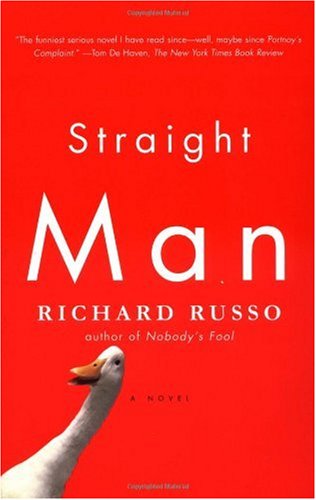
Wagner's essay was a major news story when it broke last month. I was glad to find the Atlanta Journal-Constitution's follow-up article because it allows me to mention one of my favorite novels, Richard Russo's Straight Man:
William Henry Devereaux Jr. finds himself past midlife, chair of the English department at an academic backwater, not having produced a book in 20 years, embroiled in departmental politics, maybe about to lay off colleagues, maybe on the block himself... Still, his relationships with his father, wife, daughter, and students occupy most of his time, until one day, wearing fake nose, glasses, and mustache, he threatens on TV to kill one of the campus ducks every day until his departmental budget is finalized, making the national morning talk shows.
There's a great review of Straight Man on the Tales from the Reading Room blog.