Showing posts with label poverty. Show all posts

Sunday, April 28, 2013

Philippines Underbelly & Hagedorn's Dogeaters


From Friday's ABC News article "NY Man Wanted in 2 Philippines Killings Arrested:"
Almost two years after a retired British police officer and his live-in girlfriend were shot to death as they slept in the Philippines, New York State Police said Friday they arrested one of the men accused of doing it.
Troopers worked with the FBI and Interpol for several months to track down 35-year-old Timothy Noah Kaufman...
In a posting on its website, the Philippines National Bureau of Investigation says Kaufman and two other men shot 54-year-old David Balmer and his 26-year-old girlfriend, Elma de Guia, in September 2011 as they slept in the home of Balmer's business partner, Richard Agnew, in Angeles City. Agnew discovered their bodies the next day. Philippines media report the area is in the heart of the country's sex tourism business and that Agnew owns several clubs.
For a novel that delves into the poverty and the sex trade of the Philippines, try Dogeaters by Jessica Hagedorn:
This jazzy, sardonic novel depicts the nightmare world that was the Philippines of the Marcoses...  Rich and poor, everyone sells something here; everyone has a price. The common dream of a myriad group of characters--bored teenagers, timid shop girls, male prostitutes on the make--is that hollowest of all modern apotheoses, "stardom."
A visiting filmmaker, a German degenerate, buys the services of a pretty boy, who soliloquizes: "I'll have it all worked out, soon. I know I will. I have to. I'll hit the jackpot with one of these guys. Leave town. Get lucky . . . . Soon."

Saturday, April 20, 2013

Rio's Favelas & Lins' City of God


From Wednesday's UPI article "Brazil beefs up security before pope's visit, World Cup:"
Brazil is beefing up national security in preparation for the July visit of Pope Francis, the FIFA World Cup next year and the 2016 Olympics...
The slums, known as favelas, haven't entirely disappeared despite repeated police and paramilitary operations and remain problem areas for Brazil's law enforcement agencies, including army units used occasionally when police action fails.
The favelas are seen as hotbeds of crime, drug trade and human trafficking -- blots on the image the government of President Dilma Rousseff wants to present to the pope when he visits in July, the World Cup next year and the Olympics.
Before the pontiff's visit, Brazil will also host the FIFA Confederations Cup, an international association soccer tournament conducted June 15-30, which is a prelude to the 2014 World Cup. Brazil is the defending champion.
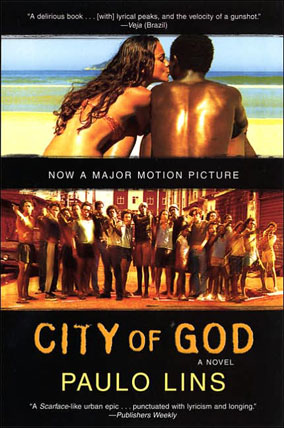
For a novel set in a favela, try City of God by Paulo Lins:
Lins's 1997 fiction debut—the source of the 2002 film published in English for the first time—chronicles two generations over three decades in the infamous Rio de Janeiro City of God, "a neo-slum of concrete, brimming dealer-doorways, sinister-silences and cries of despair."
From the slum's creation in the early 1960s for flood victims, through the rise of disco and cocaine in the 1970s, to the horrific gang wars of the 1980s, Lins traces the rise and fall of myriad, often teenaged gangsters for whom guns, girls and drugs are the tools of power.
While the film traces the divergent paths of two childhood friends, the novel rushes from vignette to vignette, with an ever-changing cast of characters with names like "Good Life," "Beelzebub" and "Hellraiser." Years, and pages, pass in a haze of smoking, drinking, snorting lines of cocaine, dancing sambas, swearing and planning the next big score. Guns dispense justice; the price for disrespect, whether to a spouse, a friend or the favela, is torture or death.
Lins, who grew up in the City, lets the horror speak for itself. He serves up a Scarface-like urban epic, bursting with encyclopedic, graphic descriptions of violence, punctuated with lyricism and longing.

Saturday, February 9, 2013

Homelessness & Swindells' Stone Cold


From today's Washington Post editorial "600 homeless children in D.C., and no one seems to care:"
The District has set a dubious new record for the number of homeless kids crammed inside a scary, abandoned hospital that serves as the city’s makeshift family homeless shelter. There are about 600, according to a nightly census done by the Community Partnership for the Prevention of Homelessness... This, of course, is happening in the same city now rolling in a $417 million budget surplus and on track for a $240 million surplus in the coming year.
A good book about homelessness is Robert Swindells' young adult novel Stone Cold. Most of the book is narrated by a newly-homeless teenager, although we get occasional interludes from the perspective of a crazed man who kills homeless people. The serial-killer storyline seems a little unnecessary, but it does add suspense. Plus, if I'm going to read/watch something about serial-killers, at least this book also gives some insight into societal ills (unlike, say, Dexter).

If you prefer classics, I've heard George Orwell's semi-autobiographical novel Down and Out in Paris and London is, like most things Orwell, excellent.  If you'd prefer a book written by someone who spent much of their life homeless, I've heard John Healy's autobiography The Grass Arena is good.

Friday, February 8, 2013

British Horsemeat Scandal & Sinclair's The Jungle

From today's CNBC article "First Burgers, Now Lasagna: Horsemeat Scandal Widens:"
Testing has confirmed that beef lasagna produced by food manufacturer Findus contained horsemeat, Britain's Food Standards Agency (FSA) said on Thursday... Investigations into suppliers have been launched in recent weeks after revelations that beef products sold at major British supermarkets including Tesco and fast food chain Burger King contained horsemeat.
Perfect book for this issue? Upton Sinclair's meat-packing classic, The Jungle:
1906 bestseller shockingly reveals intolerable labor practices and unsanitary working conditions in the Chicago stockyards as it tells the brutally grim story of a Slavic family that emigrates to America full of optimism but soon descends into numbing poverty, moral degradation, and despair. A fiercely realistic American classic that will haunt readers long after they've finished the last page.
(This description is from the book's page on Amazon.)


The book's final three chapters are politically preachy and can safely be skipped. Since the book was published in 1906, it is available free online.

Monday, February 4, 2013

U.S. Immigration Reform & Boyle's Tortilla Curtain

With Obama's and various senators' immigration reform proposals being in the news, this is a great time to read T. C. Boyle's Tortilla Curtain. Here's the description from Goodreads:
Topanga Canyon is home to two couples on a collision course. Los Angeles liberals Delaney and Kyra Mossbacher lead an ordered sushi-and-recycling existence in a newly gated hilltop community: he a sensitive nature writer, she an obsessive realtor. Mexican illegals Candido and America Rincon desperately cling to their vision of the American Dream as they fight off starvation in a makeshift camp deep in the ravine. And from the moment a freak accident brings Candido and Delaney into intimate contact, these four and their opposing worlds gradually intersect in what becomes a tragicomedy of error and misunderstanding.
The book is short, moves quickly, and does a good job of giving both sides' perspectives. I give it an A-. On a separate, non-fiction note: the Gang of Eight's immigration reform proposal in congress seems to have a lot in common with the reforms suggested in a 2010 book published by the American Enterprise Institute titled Beside the Golden Door:
"I lift my lamp beside the golden door!" the last line of Emma Lazarus's famous poem invites immigrants to enter a land of economic opportunity. Many have accepted that invitation; today, foreign-born workers make up nearly 16 percent of the U.S. workforce and account for almost half of workforce growth over the last decade. Rather than capitalizing on these gains, however, recent immigration reforms have resulted in an inefficient, patchwork system that shortchanges high-skilled immigrants and poorly serves the American public. Beside the Golden Door: U.S. Immigration Reform in a New Era of Globalization proposes a radical overhaul of current immigration policy designed to strengthen economic competitiveness and long-run growth. Pia M. Orrenius and Madeline Zavodny outline a plan that favors employment-based immigration over family reunification, making work-based visas the rule, not the exception. They argue that immigration policy should favor high-skilled workers while retaining avenues for low-skilled immigration; family reunification should be limited to spouses and minor children; provisional visas should be the norm; and quotas that lead to queuing must be eliminated. A selective immigration policy focused on high-skilled, high-demand workers will allow the United States to compete in an increasingly global economy while protecting the interests of American citizens and benefiting taxpayers.