Showing posts with label California. Show all posts

Sunday, May 12, 2013

Mother's Day, Momhood, & Tan's The Joy Luck Club


This blog has previously recommended several mom-focused novels:

Light-hearted mom novels seem a little hard to come by!

Anyway, for this mother's day my book recommendation is a classic novel about mother-daughter bonding, Amy Tan's The Joy Luck Club:
Four mothers, four daughters, four families whose histories shift with the four winds depending on who's "saying" the stories.
In 1949 four Chinese women, recent immigrants to San Francisco, begin meeting to eat dim sum, play mahjong, and talk. United in shared unspeakable loss and hope, they call themselves the Joy Luck Club. Rather than sink into tragedy, they choose to gather to raise their spirits and money. "To despair was to wish back for something already lost. Or to prolong what was already unbearable."
Forty years later the stories and history continue. With wit and sensitivity, Amy Tan examines the sometimes painful, often tender, and always deep connection between mothers and daughters. As each woman reveals her secrets, trying to unravel the truth about her life, the strings become more tangled, more entwined. Mothers boast or despair over daughters, and daughters roll their eyes even as they feel the inextricable tightening of their matriarchal ties. 
Tan is an astute storyteller, enticing readers to immerse themselves into these lives of complexity and mystery.
You might also like the list "The Top Ten Novels about Motherhood" from the Momoir Project blog.

Saturday, May 4, 2013

California Wildfires & Barr's Firestorm


From today's BBC article "California firefighters tackling six major wildfires:"
More than 3,000 firefighters are battling six major wildfires in California, the state fire agency says. One of the fiercest blazes has shut the famous Pacific Coast Highway for the second time in as many days, with a 30-mile (50-km) stretch off-limits. The so-called Springs fire has reached the coast north-west of Los Angeles, threatening thousands of homes.
For a novel about a wildfire, try Nevada Barr's murder mystery Firestorm:
A raging fire in a national park seems an unlikely setting for a murder, but that's exactly the circumstances that crime-fighting park ranger and medic Anna Pigeon confronts in this mystery thriller. A suspicious fire breaks loose in Northern California's Lassen Volcanic Park and Pigeon assists in battling the blaze and treating the wounds of other fire fighters. As if that's not enough, Pigeon finds herself without food and water trapped with a group of fire fighters, one of whom is a murderer. She tries to figure out who the culprit is before he, or the weather, strikes again.

Tuesday, April 2, 2013

Reality TV & Peltier's Reality Boulevard


From today's BBC article "French reality TV doctor kills himself after contestant dies:"
A doctor who worked on French adventure reality TV show Koh Lanta has killed himself in Cambodia after one of the programme's contestants died. In a suicide note, Thierry Costa, 38, said his name had been "sullied by the media" over the death of Gerald Babin a week ago. Mr Babin had a heart attack during filming on the island of Koh Rong. Some media reports had criticised Dr Costa, saying he had taken too much time to treat the 25-year-old. Mr Babin had complained of cramps on the first day of filming on the southern Cambodian island on 22 March. Dr Costa administered emergency care before Mr Babin was airlifted to a mainland hospital where he died. French authorities have launched a preliminary investigation into Mr Babin's death. Broadcaster TF1 announced last week it would axe the popular show, described as France's version of Survivor, in response to his death.
For a novel about reality television, try Reality Boulevard by Melissa Jo Peltier:
When Oscar-winning producer Marty Maltzman’s award-winning non-fiction series Lights and Sirens is suddenly cancelled after 16 seasons, the quirky documentary film-maker and his colorful staff find themselves unemployed and out on the streets in an artificial new Hollywood filled with Kardashians, Survivors and Real Housewives. As the collection of oddball characters adapt to a surreal world where the lines between truth and lies are blurred – both on and off the screen – this darkly funny novel reveals an insider’s view of Hollywood and Reality TV.

Wednesday, March 27, 2013

Creationism Trial & Lawrence's Inherit the Wind

So it looks like when Californians aren't fending for their lives across some dystopian civil war hellscape, they're trying to push American science back into the 19th century.  Hmmm...I think I'll take the hellscape, thanks.

From Monday's Guardian article “Creationist stakes $10,000 on contest between Bible and evolution:’
A California creationist is offering a $10,000 challenge to anyone who can prove in front of a judge that science contradicts the literal interpretation of the book of Genesis. Dr Joseph Mastropaolo, who says he has set up the contest, the Literal Genesis Trial, in the hope of improving the quality of arguments between creationists and evolutionists, has pledged to put $10,000 of his own money into an escrow account before the debate. His competitor would be expected to do the same. The winner would take the $20,000 balance. The argument would not be made in a formal court, but under an alternative dispute resolution model known as a minitrial. Mastropaolo said he would present the argument in favor of a literal interpretation of the creation story once he had found a willing scientist to argue that a non-literal interpretation of Genesis is more scientific.
This reminds me of something...oh yeah, it reminds me of a similar trial which largely settled this issue *ninety* years ago. Therefore I highly recommend that Dr. Mastropaolo, and anyone else looking for a good read, try Jerome Lawrence and Robert Lee’s play Inherit the Wind:
One of the most moving and meaningful plays in American theatre--based on the famed Scopes Monkey Trial of 1925, in which a Tennessee teacher was tried for teaching evolution… The accused was a slight, frightened man who had deliberately broken the law. His trial was a Roman circus, the chief gladiators being the two great legal giants of the century. Locked in mortal combat, they bellowed and roared imprecations and abuse.
Heliocentrists, you're next!

Tuesday, March 26, 2013

Google Glass & Gibson's Virtual Light


From today's BBC article “Privacy 'impossible' with Google Glass warn campaigners:”
Google Glass and other augmented reality gadgets risk creating a world in which privacy is impossible, warn campaigners. The warning comes from a group called "Stop the Cyborgs" that wants limits put on when headsets can be used. It has produced posters so premises can warn wearers that the glasses are banned or recording is not permitted.
If you’d like to read a book which features augmented reality glasses, try William Gibson’s science fiction novel Virtual Light:
Welcome to NoCal and SoCal, the uneasy sister-states of what used to be California. Here the millennium has come and gone, leaving in its wake only stunned survivors. In Los Angeles, Berry Rydell is a former armed-response rentacop now working for a bounty hunter. Chevette Washington is a bicycle messenger turned pick-pocket who impulsively snatches a pair of innocent-looking sunglasses. But these are no ordinary shades. What you can see through these high-tech specs can make you rich--or get you killed. Now Berry and Chevette are on the run…
For speculation on what the future of Google Glass might hold, I recommend PC World’s 2012 editorial “Google Glass Horror Stories From Your Privacy-Free Future:”
Google has amassed immense power by cataloging and analyzing the Internet, as well as selling ads there. They are masters of that universe. Like many other tech companies, however, Google isn’t satisfied with such a confined sphere of influence. Google has been searching for ways to treat things in the real world the way it treats things in the digital domain, by numbering, locating, mapping, cataloging, and analyzing them... 
What’s to prevent Google from tracking the movements of our eyeballs to discover the things that catch our attention? When I walk out of my apartment building, for example, a car might pass by that turns my head; I might glance at it in spite of myself. Could the Google Glass technology form a heat map showing the things my eyes rested on? Perhaps someday the technology will be able to measure how fast and how far I turned my head to look at something, and then develop a likelihood-to-buy score based on that. Call it the Whiplash Index. Capturing that kind of data is the stuff of fantasy for marketers, a simple and direct indication of which types of ads to push at the viewer, and when to deliver them… 
Then there’s facial recognition. That technology is unsettling enough when it identifies faces in still pictures or recorded video. But if Google Glass were connected to a server that could recognize faces, facial recognition could happen in real time. Potentially, the wearer could scan a crowd of people and see labels above those who happened to be friends of friends of friends in Google+… This might not be a big deal if just a few people in every city were to end up wearing Google Glass. But what if the device were to catch on, becoming as big as the iPhone is today? All those glasses would be collecting monstrous amounts of audio and video information every minute of every day, possibly piping the data through the network for storage in some vast server farm… Judging from the wording of Google’s overarching privacy policy and terms of use, the sounds and images that Google Glass records would not be the property of the person wearing the glasses. Google could use those sounds and images for whatever it wants.

Thursday, March 21, 2013

Town Council Politics & Rowling's The Casual Vacancy


I've previously posted about corruption in India.  How about some shady dealings a little closer to home?

From today's San Francisco Chronicle article "Ex-officials convicted in Calif. corruption case:"
Five former city councilors in a small, blue-collar Los Angeles suburb that became a symbol of political greed were convicted Wednesday of stealing taxpayer money by creating a panel that helped boost their part-time pay to nearly $100,000 a year... The trial was the first such proceeding following revelations that Bell's leadership had bilked the hardscrabble city of $5.5 million, using the money to pay huge salaries to the city manager, police chief, City Council members and others... At the heart of the case is whether the six officials broke the law by paying themselves annual salaries of up to $100,000 to govern only part-time in the city of 36,000 people where one in four residents live below the poverty line.
What's a novel about local council scheming? The Casual Vacancy by J.K. Rowling:
When Barry Fairbrother dies unexpectedly in his early forties, the little town of Pagford is left in shock. Pagford is, seemingly, an English idyll, with a cobbled market square and an ancient abbey, but what lies behind the pretty façade is a town at war. Rich at war with poor, teenagers at war with their parents, wives at war with their husbands, teachers at war with their pupils... Pagford is not what it first seems. And the empty seat left by Barry on the town’s council soon becomes the catalyst for the biggest war the town has yet seen. Who will triumph in an election fraught with passion, duplicity and unexpected revelations? Blackly comic, thought-provoking and constantly surprising, The Casual Vacancy is J.K. Rowling’s first novel for adults.

UPDATE:  There's a good review of The Casual Vacancy on Novelicious (and also on Pagelady).

Wednesday, March 20, 2013

Police, Email Warrants, & Connelly's The Black Echo


From yesterday's Guardian article "Justice Department backs rewriting law that allows police to read emails:"
The Justice Department said on Tuesday that it supports rewriting 26-year-old legislation that has allowed US law enforcement officials to read a person's emails without a search warrant so long as the email is older than six months or already opened. The law has long been criticized by privacy advocates as a loophole when it comes to protecting Americans from government snooping. "There is no principled basis to treat email less than 180 days old differently than email more than 180 days old," Elana Tyrangiel, acting assistant attorney general in the Office of Legal Policy, told a House judiciary subcommittee. She also said emails deserve the same legal protections whether they have been opened or not. Tyrangiel's testimony gives Congress a starting point as it begins to review a complicated 1986 law known as the Electronic Communications Privacy Act.

I thought it would be interesting to read a novel about a police officer's experiences in the US. Apparently I'm far from alone in this, as "police procedural" appears to be a huge and growing fiction sub-genre. I checked around, including looking at an online police forum, and here's what I came up with:
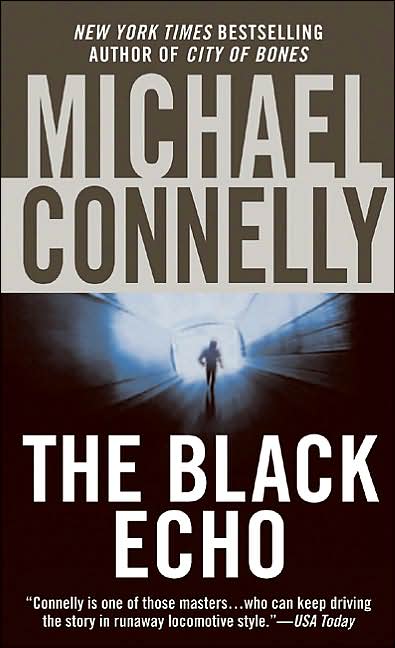
  • Michael Connelly is considered one of the best police/crime writers, and The Black Echo -- while at times clichéd and overdramatic -- appears to be a good starting point for his work:
For maverick LAPD homicide detective Harry Bosch, the body in the drainpipe at Mulholland Dam is more than another anonymous statistic. This one is personal...because the murdered man was a fellow Vietnam "tunnel rat" who had fought side by side with him in a hellish underground war. Now Bosch is about to relive the horror of Nam. From a dangerous maze of blind alleys to a daring criminal heist beneath the city, his survival instincts will once again be tested to their limit. Pitted against enemies inside his own department and forced to make the agonizing choice between justice and vengeance, Bosch goes on the hunt for a killer whose true face will shock him.
  • Suspect by Robert Crais. So the description for this novel started out fairly standard: "LAPD cop Scott James is not doing so well. Eight months ago, a shocking nighttime assault by unidentified men killed his partner Stephanie, nearly killed him, and left him enraged, ashamed, and ready to explode. He is unfit for duty...until he meets his new partner. Maggie is not doing so well, either..." At this point, I was expecting the usual trite nonsense about "Maggie, his astonishingly attractive new female partner etc etc." Instead, the author threw me a curveball and made Maggie a PTSD dog: "...Maggie is not doing so well, either. A German shepherd who survived three tours in Iraq and Afghanistan sniffing explosives before losing her handler to an IED, her PTSD is as bad as Scott's. They are each other's last chance. Shunned and shunted to the side, they set out to investigate the one case that no one wants them to touch: the identity of the men who murdered Stephanie." 
It's the 1960s. A hot August night lies heavy over the Carolinas. The corpse -- legs sprawled, stomach down on the concrete pavement, arms above the head -- brings the patrol car to a halt. The local police pick up a black stranger named Virgil Tibbs, only to discover that their most likely suspect is a homicide detective from California -- and the racially tense community's single hope in solving a brutal murder that turns up no witnesses, no motives, no clues.

Finally, I wanted to share this hilarious review of The Black Echo, by Goodreads user Kemper:
I’ve designed a gadget that will notify me when I run across clichés in crime thrillers with a *BEEP*. Let’s give it a test run on this Michael Connelly novel, shall we? So this is the first book in the series featuring a LAPD detective named Hieronymus “Harry” Bosch *BEEP*. .. ...why is it going off already? Oh, right. Quirky name for a main character. It seems to be calibrated correctly. Let’s proceed. 
In this novel published in 1992, Harry is a Vietnam veteran *BEEP* traumatized by his war experiences *BEEP* as a so-called tunnel rat who fought the VC in their network of underground passages. Harry is a driven detective whose inability to compromise often puts him at odds with his fellow cops *BEEP*. He has no family or life outside of his work *BEEP*, and he’s a borderline burn-out who lives on a diet of coffee, cigarettes and beer. *BEEP* Harry gets called to check out a dead body in a drainage pipe that everyone on the scene instantly assumes is a junkie who overdosed, but he has a hunch that it was actually a murder. *BEEP* Part of the reason Harry is convinced it was homicide is that he recognizes the victim as one of his fellow Vietnam tunnel rats. *BEEP* *BEEP* *BEEP* Damn, the old war buddy schtick really swung the needle into the red on this thing. 
Harry quickly finds evidence that the victim was involved in a high profile bank robbery that had involved tunneling into a vault and emptying the safe deposit boxes. When Harry tries to get the FBI’s attention, he meets a beautiful female agent *BEEP* *BEEP* *BEEP* named Eleanor Wish, but he also lands in hot water with his lieutenant who gets angry and yells at him a lot even though he hasn’t done anything wrong . *BEEP*. He also becomes the target of overzealous Internal Affairs cops *BEEP* that hound him even as he works with the FBI to try and solve the case. This quickly leads to a romance with Agent Wish *BEEP* *BEEP* *BEEP*..and *BEEP*….Uh oh.. I think it’s overloading…*BEEP* *BEEP* *BEEP* *BEEP* Is that smoke?? *BEEP* *BEEP* BEEP* Where’s the off switch? *BEEP* *BEEP* *BEEP**BEEEEEeeeeeeepppppp…pp..pp* Crap. I think Connelly broke it.
Anyhow, the odd thing about his book is that even though it’s got just about every cop thriller cliché you’ve ever heard of, it still works pretty well. 

UPDATE:  longer reviews of The Black Echo can be found at Carol's Notebook and Reactions to Reading.

Monday, February 25, 2013

Marijuana in the US & Boyle’s Budding Prospects


 Earlier this month we touched on the War on Drugs and its impact on Mexico.  Now it's time for a look on how it is playing out in the US.  Here's today’s Politico story “Bill unveiled to legalize medical pot:”
Flanked by more than 150 advocates from around the country, Oregon Democrat [Representative] Earl Blumenauer on Monday put forward his legislation allowing states to legalize medical marijuana in an effort to end the confusion surrounding federal pot policy. Blumeanuer’s legislation, which has 13 co-sponsors — including GOP Rep. Dana Rohrabacher of California — would create a framework for the FDA to eventually legalize medicinal marijuana. It would also block the feds from interfering in any of the 19 states where medical marijuana is legal.

For a novel about growing pot in the US, try T.C. Boyle’s Budding Prospects:
All Felix Nasmyth and friends have to do is harvest a crop of Cannabis Sativa...and half a million tax-free dollars will be theirs. But they haven't reckoned on nosy Northern California-style neighbors, torrential rain, demands of the flesh, and Felix's improbable new love, a wayward sculptress on whose behalf he undertakes a one-man vendetta against a drug-busting state trooper named Jerpbak. As their deal escalates through crises into nightmare, their dreams of easy money get nipped in the bud.

Sunday, February 24, 2013

Oscar Night, Hollywood, & Leonard's Get Shorty


 Oscar night! From today's BBC story "Oscars: Hollywood prepares for Academy Awards:"
Hollywood is gearing up for what is likely to be one of the most unpredictable Academy Awards for years. Hundreds of fans and members of the world's media are in place on the red carpet and there is tight security outside the Dolby Theatre. The ceremony is due to start at 17:30 Los Angeles time (01:30 GMT). No film is expected to sweep the board, and hostage drama Argo has overtaken historical epic Lincoln in most predictions for the best picture prize. Daniel Day-Lewis, who plays Abraham Lincoln, is favourite for best actor, while Les Miserables star Anne Hathaway is tipped for supporting actress.
What is the quintessential novel about Hollywood culture? It certainly is *not* the inexplicably popular The Day of the Locust, a poorly-written snooze-fest. I vote for Elmore Leonard's Get Shorty:
Mob-connected loanshark Chili Palmer is sick of the Miami grind -- plus his "friends" have a bad habit of dying there. So when he chases a deadbeat client out to Hollywood, Chili figures he might like to stay. This town with its dreammakers, glitter, hucksters, and liars -- plus gorgeous, partially clad would -be starlets everywhere you look -- seems ideal for an enterprising criminal with a taste for the cinematic. Besides, Chili's got an idea for a killer movie -- thought it could very possibly kill him to get it made.

Monday, February 4, 2013

U.S. Immigration Reform & Boyle's Tortilla Curtain

With Obama's and various senators' immigration reform proposals being in the news, this is a great time to read T. C. Boyle's Tortilla Curtain. Here's the description from Goodreads:
Topanga Canyon is home to two couples on a collision course. Los Angeles liberals Delaney and Kyra Mossbacher lead an ordered sushi-and-recycling existence in a newly gated hilltop community: he a sensitive nature writer, she an obsessive realtor. Mexican illegals Candido and America Rincon desperately cling to their vision of the American Dream as they fight off starvation in a makeshift camp deep in the ravine. And from the moment a freak accident brings Candido and Delaney into intimate contact, these four and their opposing worlds gradually intersect in what becomes a tragicomedy of error and misunderstanding.
The book is short, moves quickly, and does a good job of giving both sides' perspectives. I give it an A-. On a separate, non-fiction note: the Gang of Eight's immigration reform proposal in congress seems to have a lot in common with the reforms suggested in a 2010 book published by the American Enterprise Institute titled Beside the Golden Door:
"I lift my lamp beside the golden door!" the last line of Emma Lazarus's famous poem invites immigrants to enter a land of economic opportunity. Many have accepted that invitation; today, foreign-born workers make up nearly 16 percent of the U.S. workforce and account for almost half of workforce growth over the last decade. Rather than capitalizing on these gains, however, recent immigration reforms have resulted in an inefficient, patchwork system that shortchanges high-skilled immigrants and poorly serves the American public. Beside the Golden Door: U.S. Immigration Reform in a New Era of Globalization proposes a radical overhaul of current immigration policy designed to strengthen economic competitiveness and long-run growth. Pia M. Orrenius and Madeline Zavodny outline a plan that favors employment-based immigration over family reunification, making work-based visas the rule, not the exception. They argue that immigration policy should favor high-skilled workers while retaining avenues for low-skilled immigration; family reunification should be limited to spouses and minor children; provisional visas should be the norm; and quotas that lead to queuing must be eliminated. A selective immigration policy focused on high-skilled, high-demand workers will allow the United States to compete in an increasingly global economy while protecting the interests of American citizens and benefiting taxpayers.