Showing posts with label Europe. Show all posts

Sunday, May 12, 2013

Mongolian Dino Bones, Paleontology, & Chevalier's Remarkable Creatures


From yesterday's BBC article "US to return more smuggled dinosaurs to Mongolia:"
The US is to return more than a dozen illegally smuggled dinosaur skeletons to Mongolia. The announcement follows the handing over to Mongolian officials on Monday of a 70-million-year-old Tyrannosaurus bataar at a ceremony in New York.
The latest group includes two more Tyrannosaurus bataars, six Oviraptors and several Gallimimuses. ...   A Florida fossils dealer admitted smuggling the bones of the Tyrannosaurus which was handed back on Monday, which sold at auction for more than $1m (£643,000).
Jurassic Park opens with some good scenes of paleontologists at work, but quickly morphs into a dino-fighting adventure novel. For a novel that is entirely focused on the paleontologists themselves, try Remarkable Creatures by Tracy Chevalier:
In 1810, a sister and brother uncover the fossilized skull of an unknown animal in the cliffs on the south coast of England. With its long snout and prominent teeth, it might be a crocodile – except that it has a huge, bulbous eye.
Remarkable Creatures is the story of Mary Anning, who has a talent for finding fossils, and whose discovery of ancient marine reptiles such as that ichthyosaur shakes the scientific community and leads to new ways of thinking about the creation of the world.
Working in an arena dominated by middle-class men, however, Mary finds herself out of step with her working-class background. In danger of being an outcast in her community, she takes solace in an unlikely friendship with Elizabeth Philpot, a prickly London spinster with her own passion for fossils.
The strong bond between Mary and Elizabeth sees them through struggles with poverty, rivalry and ostracism, as well as the physical dangers of their chosen obsession. It reminds us that friendship can outlast storms and landslides, anger and jealousy.

Friday, May 10, 2013

Giro d'Italia, Tour de France, & Krabbé's The Rider


From last week's New York Times article "Tour de France Champion to Headline the Giro d’Italia:"
With its systemic corruption, fractious leadership, an entrenched code of silence and some of its members recently embroiled in a high-profile drug trial, professional cycling these days often seems to resemble organized crime more than sport...
Fitting, then, that the cycling world will gather in Naples on Saturday — not for Camorra-like clandestine meetings, but to start the Giro d’Italia, the three-week Grand Tour that signals the start of the sport’s high season.
Recent editions of the Giro have been short on star power, but organizers have managed to up the wattage considerably this year by attracting Bradley Wiggins, the defending Tour de France champion, to headline the 21-stage race that will span 3,405 kilometers, or 2,116 miles...
The Giro is often considered the most grueling of the Grand Tours, which also include the Tour de France and the Vuelta a España. It is a physically demanding challenge that can be, at times, absurdly so. In 2009, the peloton staged a protest after a series of dangerous stages, including one where Spanish rider Pedro Horrillo ended up in a coma after a mountain crash.
For a novel about bicycle racing, try The Rider by Tim Krabbé:
At the start of this chronicle of a single bike race, the author glances up from his gear to assess the crowd of spectators. "Non-racers," he writes. "The emptiness of those lives shocks me."
In immediate, living prose, Krabbé, a novelist as well as a cyclist, takes us with him, inch by inch, as he rides the hundred-and-thirty-seven-kilometre Tour de Mont Aigoual, a course through the mountains that is better known as one of the cruellest stages of the Tour de France.
He imagines an official collecting his clothes "after I've died in the race" recalls a champion cyclist who suffocated to death while climbing one particularly nasty hill; and insists that "being a good loser is a despicable evasion."
Along the way, he lays bare the athlete's peculiar mixture of arrogance and terror, viciousness and camaraderie, and the result is one of the more convincing love stories of recent memory.
Another Tour de France novel is The Race by Dave Shields:
The white-knuckle pace of a bicycle race drives this novel about a young American's opportunity to compete in the Tour de France. Complex relationships with teammates, personal and professional obstacles, and a terrible disaster cause the young cyclist to redefine his limits.
An insider's perspective on the world of professional bicycle racing which reveals that the required tactics and skills create a culture in which pain is the ultimate currency and endurance is the most powerful force.

Tuesday, April 30, 2013

Queen Beatrix's Abdication, the Netherlands, & Koch's The Dinner


Today's BBC headline is "Dutch Queen Beatrix abdicates in favour of son:"
Queen Beatrix of the Netherlands has handed the throne to her son Prince Willem-Alexander. The 75-year-old monarch signed the instrument of abdication in Amsterdam after 33 years on the throne. Willem-Alexander has now become the country's first king since 1890.
To dig a little deeper, here's the Irish Times article "Dutch royals search for role as gossip-obsessed media circles new prey:"
Fond as the Dutch are of the departing Queen Beatrix, who abdicates today after 33 years on the throne, at 75 she has only limited gossip potential. On the other hand, Willem-Alexander’s Argentinian investment banker wife, Maxima, who becomes queen today, generates endless “glamour” interest, and their three daughters – known by their parents as “the Triple As” – still have their teenage years ahead of them, packed with “red-top” potential. ["Red-top" is a UK term for tabloids.]
For a novel set in the Netherlands, you have several options based on your genre tastes.

For literary fiction, try The Dinner by Herman Koch:
It's a summer's evening in Amsterdam, and two couples meet at a fashionable restaurant for dinner. Between mouthfuls of food and over the polite scrapings of cutlery, the conversation remains a gentle hum of polite discourse -- the banality of work, the triviality of the holidays. But behind the empty words, terrible things need to be said, and with every forced smile and every new course, the knives are being sharpened.
Each couple has a fifteen-year-old son. The two boys are united by their accountability for a single horrific act; an act that has triggered a police investigation and shattered the comfortable, insulated worlds of their families. As the dinner reaches its culinary climax, the conversation finally touches on their children. As civility and friendship disintegrate, each couple show just how far they are prepared to go to protect those they love.
Tautly written, incredibly gripping, and told by an unforgettable narrator, The Dinner promises to be the topic of countless dinner party debates. Skewering everything from parenting values to pretentious menus to political convictions, this novel reveals the dark side of genteel society and asks what each of us would do in the face of unimaginable tragedy.
For historical fiction, try The Assault by Harry Mulisch:
It is the winter of 1945, the last dark days of the ware in occupied Holland. A Nazi collaborator, infamous for his cruelty, is assassinated as he rides on his bicycle. The Germans retaliate by slaughtering an innocent family: only the youngest son, twelve-year-old Anton, survives. 
The Assault traces the complex repercussions of this nightmarish event on Anton's life. Determined not to forget, he opts for a carefully normal existence—a prudent marriage, a successful career, and colorless passivity. But the past keeps breaking through, in relentless memories and in chance encounters with the other actors in the drama, until Anton finally learns what really happened that night in 1945, and why.
For a murder mystery, you might like Dutch Me Deadly by Maddy Hunter:
As a travel escort for seniors, Emily Andrew-Miceli has led her feisty Iowa clan all over the world. This time, they're off to see historic windmills, classic Rembrandts, and picturesque canals in Holland - if they can ever unplug from their smartphones, that is.
Joining them is the high school class from Bangor, Maine, whose 50th reunion celebration goes south faster than a fallen Brussel sprout soufflé as old rivalries start heating up. Worse, Emily's hopes for a 100% survival rate on this trip are dashed when an important member of the tour suffers a tragic (and highly suspicious) accident.
Then the saucy seniors' wild night of drug-laced desserts and risqué shows in Amsterdam's infamous Red Light District gets even more mysterious when one unpopular reunioner goes missing…
And for a thriller, try the soon-to-be-published Choke Point by Ridley Pearson:
When an award-winning foreign journalist reveals the existence of an Amsterdam-based sweatshop known as a “knot shop” that employs and enslaves young girls as laborers, private security firm Rutherford Risk is hired by a philanthropist to find it and shut it down. David “Sarge” Dulwich, Knox’s former boss from their government contractor days, knows that Knox's cultural knowledge, combat skills, and sympathy for the abused make him right for the job.
Joined by Grace Chu, whose more subtle skills for acquiring sensitive tech information help to balance Knox's improvisational style, he heads to Amsterdam in an attempt to dismantle the child labor operation and rescue the girls. In their way is a crime organization that has permeated the neighborhoods with goodwill turning even the victims' parents against their would-be saviors. With enemies around every corner, Knox and Grace can't tell the good from the bad. [Due out 4 June 2013].


Tuesday, March 26, 2013

Neo-Nazis in Europe & Mankell's The Return of the Dancing Master


Now that I've covered one of the most popular US crime novels, it's time for some Nazi-busting detectives from Europe!

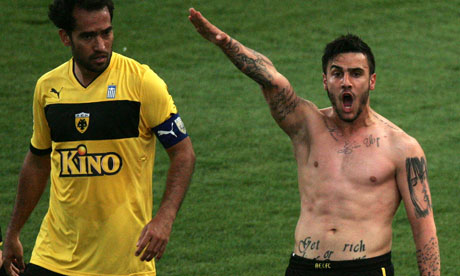
But first, the news.  Here's last week's BBC article "Greek footballer Giorgos Katidis banned for Nazi salute:"
A Greek footballer has been banned for life from playing for the national team after making a Nazi salute. AEK Athens midfielder Giorgos Katidis, 20, made the gesture to celebrate his winning goal during a Saturday match. The Greek football federation called it "a severe provocation" that insulted "all the victims of Nazi bestiality". Katidis denied he gave a Nazi salute. "I am not a fascist and would not have done it if I had known what it meant," Katidis said on his Twitter account.
I think he originally claimed that he was "pointing at a friend in the stands," which is ridiculous because it certainly looked like a Nazi salute.

Want to read a novel about neo-Nazism in Europe? While The Girl with the Dragon Tattoo features neo-Nazis, a Swedish novel that focuses more closely on them is The Return of the Dancing Master by Henning Mankell:
When retired policeman Herbert Molin is found brutally slaughtered on his remote farm in the northern forests of Sweden, police find strange tracks in the snow — as if someone had been practicing the tango. Stefan Lindman, a young police officer recently diagnosed with mouth cancer, decides to investigate the murder of his former colleague, but is soon enmeshed in a mystifying case with no witnesses and no apparent motives. Terrified of the disease that could take his life, Lindman becomes more and more reckless as he unearths the chilling links between Molin’s death and an underground neo-Nazi network that runs further and deeper than he could ever have imagined.

Thursday, March 21, 2013

Modeling & Porizkova's A Model Summer


There's a fierce debate afoot in the comments section of the Guardian article "Has the Esquire editor escaped from a Benny Hill sketch?:"
According to Bilmes, Esquire uses pictures of women in his magazine "in the same way we provide pictures of cool cars". "The women that we feature in the magazine are ornamental," he said while speaking on a panel about feminism in the media and advertising. "I could lie to you and say we are interested in their brains as well. We are not. They are objectified."...  Lovely as Bilmes sounds, I can't help wondering whether or not he may also be in possession of a time-travelling automobile, as he is clearly stumbling around the wrong century. Isn't there a Benny Hill sketch somewhere, missing a ruddy-faced pervert?
The most popular comment arguing that it is okay to objectify women in a magazine is one by StVitusGerulaitis:
They [Esquire] are mainly using models as ornaments. That's what models are for. They know that when they take the job and are well paid. Same for male models. There's nothing wrong with appreciating the aesthetic value of other people. We are beautiful animals on the whole.
Regardless of where you stand on that debate, I have a novel for you about modeling, which might give us more perspective into the whole issue. Although the writing is so-so, the upside is that it was written by a former supermodel, so the author knows what she's talking about. The book is A Model Summer by Paulina Porizkova:
An incisive, beautifully written first novel by a former supermodel that explores the glamorous and gritty world she inhabitedOnly a handful of women in the world have experienced what Paulina Porizkova has -- being whisked away to model in Paris while still a teenager, reaching the pinnacle of the profession before her schoolmates had even graduated -- and fewer still have the insight to capture it on paper. In her first novel, Paulina tells the story of Jirina. A tall, scrawny fifteen-year-old girl from Sweden, she's much more accustomed to taunts and disdain than admiration and affection, whether from her classmates or her own family. That all changes when her only friend, Hatty, asks to practice her makeup and photography skills on Jirina. Almost before she knows it Jirina is on a plane to Paris, where she will spend the summer in a milieu entirely alien to her. Living at the home of her modeling agency's owner and constantly subjected to blunt physical assessments, catty and often cruel fellow models, and womanizing photographers...Jirina embarks on a journey beyond her wildest imaginings.

UPDATE:  for a longer review of the novel, please check out the I Read Too Much blog.

Bolshoi Ballet & McCann's Dancer


From yesterday's BBC article "Bolshoi ballet was 'giant brothel' claims former dancer:"
The Bolshoi Ballet has been mired in further controversy after a former soloist claimed female dancers were forced to sleep with wealthy patrons. Anastasia Volochkova accused the theatre's general director of turning the company "into a giant brothel". Outspoken Volochkova, who has dabbled in TV talent and talk shows, was fired from the Bolshoi in 2003 for being too heavy... "It mainly happened with the corps du ballet but also with the soloists," she said. "Ten years ago, when I was dancing at the theatre, I repeatedly received such propositions to share the beds of oligarchs. "The girls were forced to go along to grand dinners and given advance warning that afterwards they would be expected to go to bed and have sex," she alleged. "When the girls asked: 'What happens if we refuse?', they were told that they would not go on tour or even perform at the Bolshoi theatre. Can you imagine?" It is the latest in a series of controversial events surrounding the world famous Russian theatre, which has become notorious for infighting and rivalry. One of its top dancers, Pavel Dmitrichenko, is facing trial for allegedly ordering an acid attack on the ballet's artistic director Sergei Filin in January.
For a novel about the Russian ballet in relatively modern times (late 20th century), try Dancer by Colum McCann:
Dancer is the erotically charged story of the Russian dancer Rudolf Nureyev as told through the cast of those who knew him: there is Anna Vasileva, Rudi's first ballet teacher, who rescues her protégé from the stunted life of his provincial town; Yulia, whose sexual and artistic ambitions are thwarted by her Soviet-sanctioned marriage; and Victor, the Venezuelan street hustler, who reveals the lurid underside of the gay celebrity set. Spanning four decades and many worlds, from the horrors of the Second World War to the wild abandon of New York in the eighties, Dancer is peopled by a large cast of characters, obscure and famous: doormen and shoemakers, nurses and translators, Margot Fonteyn, Eric Bruhn and John Lennon. And at the heart of the spectacle stands the artist himself, willful, lustful, and driven by a never-to-be-met need for perfection.

UPDATE:  there are well-written reviews of Dancer over at Bite the Book, The Book Chick, and Seeing the World Through Books.

Wednesday, March 6, 2013

Spain: Jews Wanted (a.k.a. The Inquisition & Gordon's The Last Jew)


From today’s BBC article “Sephardic Jews invited back to Spain after 500 years:”
More than 500 years ago, tens of thousands of Jews fled Spain because of persecution. Now their descendants are being invited to return. Before the infamous Spanish Inquisition of the 15th Century, some 300,000 Jews lived in Spain. It was one of the largest communities of Jews in the world. Today, there are about 40,000 or 50,000 - but that number could be about to swell dramatically. In November, Spain's justice minister Alberto Ruiz-Gallardon announced a plan to give descendants of Spain's original Jewish community - known as Sephardic Jews - a fast-track to a Spanish passport and Spanish citizenship.

What was it like to be Jewish during the Spanish Inquisition? To place yourself in the moment, read Noah Gordon’s novel The Last Jew:
In the year 1492, the Inquisition has all of Spain in its grip. After centuries of pogrom-like riots encouraged by the Church, the Jews - who have been an important part of Spanish life since the days of the Romans - are expelled from the country by royal edict...some perish even before they can escape from Spain. Yonah Toledano, the 15-year-old son of a celebrated Spanish silversmith, has seen his father and brother die during these terrible days...  Yonah begins a meandering journey, a young fugitive zigzagging across the vastness of Spain...in a time and land where danger from the Inquisition is everywhere...

If the Inquisition interests you, you might also like:

  • By Fire, By Water by Mitchell James Kaplan (“Luis de Santángel, chancellor to the court and longtime friend of the lusty King Ferdinand, has had enough of the Spanish Inquisition…[b]ut he is from a family of conversos, and his Jewish heritage makes him an easy target…”) and 
  • Incantation by Alice Hoffman (“Growing up in Spain around 1500 in the village where her family has lived for 500 years, Estrella, 16, knows that there are secrets in her home. As books are burned in the streets, and Jews from the nearby ghetto are murdered, she confronts the reality that she is a Marrano, part of a community of underground Jews…”).

*Note:  some people find the term "Jew" pejorative (as opposed to, say, "Jewish person").  I just want to make it clear that I don't use the term pejoratively and don't intend for it to be misinterpreted that way.

Monday, March 4, 2013

Spielberg's Napoleon Miniseries & Scarrow's Young Bloods


From today's BBC story "Spielberg to develop Kubrick's Napoleon for TV:"
Steven Spielberg is to give life to a screenplay by Stanley Kubrick about Napoleon, which was scrapped by the late film maker in the 1970s. He told French TV network Canal+ he would make a TV miniseries - not a film - about the life of the French Emperor... Regarded as one of the greatest filmmakers of all time, Kubrick directed groundbreaking films including 2001: A Space Odyssey...  According to the Hollywood Reporter, he was "devoted" to the research involved in the biopic about Napoleon, spending years exploring the French emperor's life in detail.
If you want a rollicking story about Napoleon's life, you don't have to wait for the Spielberg miniseries. Try Simon Scarrow's Young Bloods:
Europe in the late eighteenth century was a tumultuous place, with war and rebellions breaking out on many fronts. Young Arthur Wesley (later Wellington) and Napoleon Bonaparte grow up worlds apart yet immersed from youth in a culture where a military career is a natural choice for men of ambition. While Wellington is blooded in Ireland and Flanders, Napoleon is caught up in the dramas of the French Revolution and war with Prussia, Britain and Holland. None of this is enough to distract Wellington from his pursuit of Kitty Pakenham or Napoleon from his future bride, Josephine, for these men throw themselves into all aspects of life as enthusiastically as they rush to battle.
The courting scenes between Wellington and Kitty are cringe-worthy, but the rest of the novel is good.