Showing posts with label computers. Show all posts

Friday, April 26, 2013

Video Games, World of Warcraft, & Stephenson's Reamde


Here's Wednesday's Forbes article, "Chasing Dragons: How A Misunderstanding Of Video Games Led To The 38 Studios Disaster:"
It seems like a simple tale. Almost an admirable one. A retired sports star loved video games so much, he wanted to make one of his own...
Unfortunately, Curt Schilling’s 38 Studios now stands as a cautionary tale on overreaching expectations in the video game industry...
Schilling...was shooting for the moon... The game was Kingdoms of Amalur: Reckoning, meant to be a World of Warcraft style sword and sorcery MMO... After all, how hard could it be to make another World of Warcraft?
That’s a question that would make anyone with even a passing interesting in gaming burst out laughing... For as much as Schilling claimed to love gaming, he was entirely delusional about the ease of crafting smash hits in the genre. Companies far more established than his have been trying to make a dent in World of Warcraft’s armor for a decade now
For a novel about the creation of a World of Warcraft-like game, try Reamde by Neal Stephenson:
Four decades ago, Richard Forthrast, the black sheep of an Iowa family, fled to a wild and lonely mountainous corner of British Columbia to avoid the draft. Smuggling backpack loads of high-grade marijuana across the border into Northern Idaho, he quickly amassed an enormous and illegal fortune.
With plenty of time and money to burn, he became addicted to an online fantasy game in which opposing factions battle for power and treasure in a vast cyber realm. Like many serious gamers, he began routinely purchasing virtual gold pieces and other desirables from Chinese gold farmers—young professional players in Asia who accumulated virtual weapons and armor to sell to busy American and European buyers.
For Richard, the game was the perfect opportunity to launder his aging hundred dollar bills and begin his own high-tech start up—a venture that has morphed into a Fortune 500 computer gaming group, Corporation 9592, with its own super successful online role-playing game, T’Rain.
But the line between fantasy and reality becomes dangerously blurred when a young gold farmer accidently triggers a virtual war for dominance—and Richard is caught at the center.

Tuesday, March 26, 2013

Google Glass & Gibson's Virtual Light


From today's BBC article “Privacy 'impossible' with Google Glass warn campaigners:”
Google Glass and other augmented reality gadgets risk creating a world in which privacy is impossible, warn campaigners. The warning comes from a group called "Stop the Cyborgs" that wants limits put on when headsets can be used. It has produced posters so premises can warn wearers that the glasses are banned or recording is not permitted.
If you’d like to read a book which features augmented reality glasses, try William Gibson’s science fiction novel Virtual Light:
Welcome to NoCal and SoCal, the uneasy sister-states of what used to be California. Here the millennium has come and gone, leaving in its wake only stunned survivors. In Los Angeles, Berry Rydell is a former armed-response rentacop now working for a bounty hunter. Chevette Washington is a bicycle messenger turned pick-pocket who impulsively snatches a pair of innocent-looking sunglasses. But these are no ordinary shades. What you can see through these high-tech specs can make you rich--or get you killed. Now Berry and Chevette are on the run…
For speculation on what the future of Google Glass might hold, I recommend PC World’s 2012 editorial “Google Glass Horror Stories From Your Privacy-Free Future:”
Google has amassed immense power by cataloging and analyzing the Internet, as well as selling ads there. They are masters of that universe. Like many other tech companies, however, Google isn’t satisfied with such a confined sphere of influence. Google has been searching for ways to treat things in the real world the way it treats things in the digital domain, by numbering, locating, mapping, cataloging, and analyzing them... 
What’s to prevent Google from tracking the movements of our eyeballs to discover the things that catch our attention? When I walk out of my apartment building, for example, a car might pass by that turns my head; I might glance at it in spite of myself. Could the Google Glass technology form a heat map showing the things my eyes rested on? Perhaps someday the technology will be able to measure how fast and how far I turned my head to look at something, and then develop a likelihood-to-buy score based on that. Call it the Whiplash Index. Capturing that kind of data is the stuff of fantasy for marketers, a simple and direct indication of which types of ads to push at the viewer, and when to deliver them… 
Then there’s facial recognition. That technology is unsettling enough when it identifies faces in still pictures or recorded video. But if Google Glass were connected to a server that could recognize faces, facial recognition could happen in real time. Potentially, the wearer could scan a crowd of people and see labels above those who happened to be friends of friends of friends in Google+… This might not be a big deal if just a few people in every city were to end up wearing Google Glass. But what if the device were to catch on, becoming as big as the iPhone is today? All those glasses would be collecting monstrous amounts of audio and video information every minute of every day, possibly piping the data through the network for storage in some vast server farm… Judging from the wording of Google’s overarching privacy policy and terms of use, the sounds and images that Google Glass records would not be the property of the person wearing the glasses. Google could use those sounds and images for whatever it wants.

Thursday, March 21, 2013

Sexual Harassment at Work & Crichton's Disclosure


From yesterday's Washington Post article "Judge sets aside $3.5 million civil verdict in sexual harassment case:"
A federal judge has set aside a $3.5 million jury award to a former public pool lifeguard in the District who alleged she was sexually harassed by a supervisor and then fired in retaliation for complaining about the conduct. Chief U.S. District Judge Royce C. Lamberth, who presided over the trial last summer, wrote this week that the conduct alleged is “no doubt disgusting and extremely troubling, and the jury had good reason to be disturbed by the facts.” But he agreed with the District’s Attorney General that the jury’s award to the former Takoma Aquatic Center lifeguard was “so great as to shock the conscience” and “inordinately large.” Lamberth gave Carmen Jean-Baptiste 21 days to accept a smaller $350,000 award or chose a new trial on the issue of damages... At trial, Jean-Baptiste alleged that her supervisor, Rodney Weaver, spoke to her in sexually crude language, propositioned her and ogled her while she stood before him in her bathing suit, according to court documents. The District failed to respond to her complaints even after she spoke with six supervisors at various levels, she testified. Soon after filing a written complaint in October 2006, Jean-Baptiste was fired.
I imagine that there are probably a lot more instances of sexual harassment in the workplace, but we don't hear about it in the news because (a) it goes unreported or (b) if it is reported, it's handled in-house or quietly settled in order to avoid bad press.

For a novel about workplace sexual harassment, try Michael Crichton's Disclosure. My own disclosure to you is that it is becoming increasingly clear that Crichton, whose writing style I really admire (see last month's post on Airframe/airline glitches and Sunday's post on State of Fear/global warming), is a sexist.

When I first read Disclosure -- which, in addition to sexual harassment, also focuses on affirmative action policies -- it seemed like Crichton used the book as a means of exploring and debating affirmative action and that both sides get, more or less, a fair shake. But now that I'm re-reading the book, it's increasingly clear that while some characters do speak on behalf of the "women should hold more positions of power" perspective, those characters are usually despicable. Crichton's not as bad as Ayn Rand -- with her comic-book-worthy demi-god mouthpiece protagonists and her sniveling side characters that put forth straw-man arguments for all things Rand disagrees with -- but upon re-reading Disclosure seems sexist.  For example, the two main male characters which argue in favor of appointing a woman to the second-highest position in the company are the deranged boss and the two-faced lawyer.  Our near-flawless protagonist, the hard-working Tom Sanders, just wants positions to be decided by merit.  And of course, the woman in the novel who has been appointed to the company's second-highest position is not only less qualified than poor ol' Tom Sanders, but is also CRAZY.  Crichton writes well enough that you don't initially notice how contrived the whole scenario is.

Anyway: rant over! Here's the description of Disclosure (which, despite its flaws, is worth reading):
Beautiful, bright, and talented Meredith Johnson arrives at Digital Communications Technology company to become the head of a division, a position that Tom Sanders thought was going to be his. Meredith, his former lover, invites him to her office after hours and attempts to seduce him. When he rejects her, she accuses him of sexual harassment. Tom hires Louise Fernandez to defend him and reverses the accusation to name Meredith as the aggressor. To this plot, Crichton adds computer-industry sabotage, corporate mergers, video-linkups, stock options, CD-ROM jargon, and even a trip on a virtual-reality simulator to help Tom save his reputation and career.
As a final note, I find Demi Moore and Michael Douglas' exaggerated expressions on the book cover kind of hilarious.

UPDATE:  here's a longer review of Disclosure over at the Book in the Bag blog.

Tuesday, March 19, 2013

Facebook vs App Developers & Mezrich's The Accidental Billionaires


From today's Wall Street Journal article "Tensions Rise Between Facebook, Developers:"
Last month in Paris, developer Antoine Morcos received an unexpected email: Facebook said it was cutting ties with his photo-sharing application, Vintage Camera. Mr. Morcos, 31 years old, instantly lost nearly half a million registered users who only accessed Vintage Camera through the social-networking site. Facebook, without being specific, said too many users had complained about Vintage Camera, said Mr. Morcos. He appealed, arguing his app fielded less than three complaints for every 1,000 photos shared, but Facebook didn't budge. "I was really shocked," Mr. Morcos said. "Users were sharing as much as 6,000 photos per day on Facebook; now access is blocked." 
Vintage Camera, which competes with Facebook's Instagram app, is one of a growing number of third-party apps that have been blocked by the social network recently. Facebook has long had a complex relationship with developers as it balances a complicated set of interests. The company says it is stepping up efforts to police the network by curbing spam and restricting apps that aren't adding sufficient value to the network. Developers say the crackdown is an attempt to stifle applications that compete with Facebook-owned services or part of an effort to get developers to pay for ads on Facebook...
On Friday, Facebook blocked MessageMe Inc., a messaging service that had just launched days earlier, from accessing users' friends list. Arjun Sethi, a MessageMe co-founder, said Facebook cited a section of its policy that addressed restricting apps that copied a core Facebook product or service. According to people familiar with the matter, the fledgling service had recently rebuffed takeover interest from the social networking company.

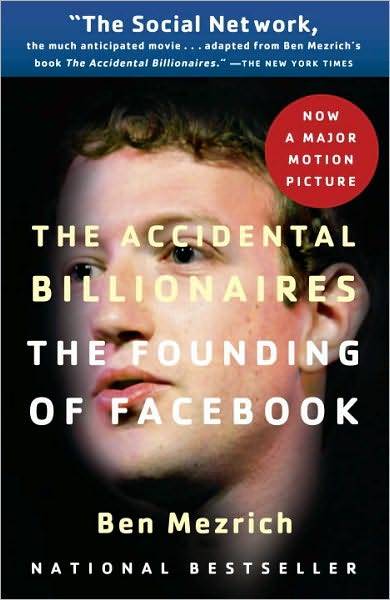
To see what makes Facebook tick, you might look into how it all started by reading Ben Mezrich's novel The Accidental Billionaires (which was the basis for the film The Social Network):
Best friends Eduardo Saverin and Mark Zuckerberg had spent many lonely nights looking for a way to stand out among Harvard University’s elite, comptetitive, and accomplished student body. Then, in 2003, Zuckerberg hacked into Harvard’s computers, crashed the campus network, almost got himself expelled, and was inspired to create Facebook, the social networking site that has since revolutionized communication around the world. With Saverin’s funding their tiny start-up went from dorm room to Silicon Valley. But conflicting ideas about Facebook’s future transformed the friends into enemies. Soon, the undergraduate exuberance that marked their collaboration turned into out-and-out warfare as it fell prey to the adult world of venture capitalists, big money, lawyers.
Keep in mind that since Mezrich's sources were Zuckerberg's enemies and not Zuckerberg himself, you should take the account with a grain of salt.

Thursday, March 14, 2013

Cyber Attacks, Cyber Terrorism, & Russinovich's Zero Day


Earlier today I posted about drones.  Now we can read about another new technology used in warfare:  cyber attacks.  Here's Tuesday's NBC article "Cyber attacks are leading threat against US: spy agencies:"
Intelligence leaders said for the first time on Tuesday that cyber attacks and cyber espionage have supplanted terrorism as the top security threat facing the United States... They expressed concern that computer technology is evolving so quickly it is hard for security experts to keep up. "In some cases, the world is applying digital technologies faster than our ability to understand the security implications and mitigate potential risks," James Clapper, the director of National Intelligence, told the committee... On Monday, White House national security adviser Tom Donilon, citing complaints from U.S. businesses about alleged Chinese cyber espionage, said the issue is a growing challenge to economic relations between the United States and China.

For a novel on cyber attacks, try Zero Day by Mark Russinovich:
An airliner's controls abruptly fail mid-flight over the Atlantic. An oil tanker runs aground in Japan when its navigational system suddenly stops dead. Hospitals everywhere have to abandon their computer databases when patients die after being administered incorrect dosages of their medicine. In the Midwest, a nuclear power plant nearly becomes the next Chernobyl when its cooling systems malfunction. At first, these random computer failures seem like unrelated events. But Jeff Aiken, a former government analyst who quit in disgust after witnessing the gross errors that led to 9/11, thinks otherwise. Jeff fears a more serious attack targeting the U.S. computer infrastructure is already under way. And as other menacing computer malfunctions pop up around the world, some with deadly results, he realizes that there isn't much time if he hopes to prevent an international catastrophe.

If you want further news coverage about cyber attacks, another interesting article from Tuesday was the New York Times' "Security Leader Says U.S. Would Retaliate Against Cyberattacks:"
The chief of the military’s newly created Cyber Command told Congress on Tuesday that he is establishing 13 teams of programmers and computer experts who could carry out offensive cyberattacks on foreign nations if the United States were hit with a major attack on its own networks, the first time the Obama administration has publicly admitted to developing such weapons for use in wartime.

Wednesday, March 13, 2013

Drones & Suarez's Kill Decision


Drones have frequently been in the news over the last year, and their increasing use by the U.S. military is a contentious issue in American politics.  Last week, Senator Paul's filibuster brought the drone issue to a head.  Here are the highlights from the relevant BBC article, "Senator Rand Paul's drone filibuster delays CIA nomination:"
A Republican US senator has delayed the nomination of a new CIA chief over questions about the possible use of drones against Americans. Senator Rand Paul spoke without a pause for nearly 13 hours, in a tactic known as a filibuster, before yielding the floor... Sen Paul - a critic of the use of drones - demanded a pledge from either President Obama or Attorney General Eric Holder that drones would not be used in the US to kill terror suspects who are US citizens... The Kentucky senator said he was "alarmed" by how difficult it had been to get President Barack Obama's administration to clearly define what qualifies as a legitimate target of a drone strike. "No president has the right to say he is judge, jury and executioner,'' Sen Paul said, adding he would end the filibuster if the White House clarified no such attack would happen on US soil.
For a novel on drones, try Kill Decision by Daniel Suarez:
Unmanned weaponized drones already exist—they’re widely used by America in our war efforts in the Middle East. In Kill Decision, bestselling author Daniel Suarez takes that fact and the real science behind it one step further, with frightening results. Linda McKinney is a myrmecologist, a scientist who studies the social structure of ants. Her academic career has left her entirely unprepared for the day her sophisticated research is conscripted by unknown forces to help run an unmanned—and thanks to her research, automated—drone army. Odin is the secretive Special Ops soldier with a unique insight into the faceless enemy who has begun to attack the American homeland with drones programmed to seek, identify, and execute targets without human intervention. Together, McKinney and Odin must slow this advance long enough for the world to recognize its destructive power, because for thousands of years the “kill decision” during battle has remained in the hands of humans—and off-loading that responsibility to machines will bring unintended, possibly irreversible, consequences.

UPDATE:  there are some longer reviews of Kill Decision over at the Daqri and ZenPundit blogs.