Showing posts with label Latin America. Show all posts

Saturday, April 20, 2013

Rio's Favelas & Lins' City of God


From Wednesday's UPI article "Brazil beefs up security before pope's visit, World Cup:"
Brazil is beefing up national security in preparation for the July visit of Pope Francis, the FIFA World Cup next year and the 2016 Olympics...
The slums, known as favelas, haven't entirely disappeared despite repeated police and paramilitary operations and remain problem areas for Brazil's law enforcement agencies, including army units used occasionally when police action fails.
The favelas are seen as hotbeds of crime, drug trade and human trafficking -- blots on the image the government of President Dilma Rousseff wants to present to the pope when he visits in July, the World Cup next year and the Olympics.
Before the pontiff's visit, Brazil will also host the FIFA Confederations Cup, an international association soccer tournament conducted June 15-30, which is a prelude to the 2014 World Cup. Brazil is the defending champion.
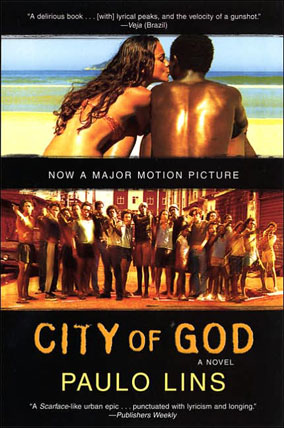
For a novel set in a favela, try City of God by Paulo Lins:
Lins's 1997 fiction debut—the source of the 2002 film published in English for the first time—chronicles two generations over three decades in the infamous Rio de Janeiro City of God, "a neo-slum of concrete, brimming dealer-doorways, sinister-silences and cries of despair."
From the slum's creation in the early 1960s for flood victims, through the rise of disco and cocaine in the 1970s, to the horrific gang wars of the 1980s, Lins traces the rise and fall of myriad, often teenaged gangsters for whom guns, girls and drugs are the tools of power.
While the film traces the divergent paths of two childhood friends, the novel rushes from vignette to vignette, with an ever-changing cast of characters with names like "Good Life," "Beelzebub" and "Hellraiser." Years, and pages, pass in a haze of smoking, drinking, snorting lines of cocaine, dancing sambas, swearing and planning the next big score. Guns dispense justice; the price for disrespect, whether to a spouse, a friend or the favela, is torture or death.
Lins, who grew up in the City, lets the horror speak for itself. He serves up a Scarface-like urban epic, bursting with encyclopedic, graphic descriptions of violence, punctuated with lyricism and longing.

Sunday, March 17, 2013

Pope Francis, Argentina's Dirty War, & Englander's The Ministry of Special Cases


From Friday's Washington Post article "Vatican defends Pope Francis against Argentina ‘Dirty War’ allegations:"
The Vatican vigorously defended Pope Francis on Friday by seeking to discredit accusations that he failed to oppose and may even have collaborated with Argentina’s feared military junta during the so-called “dirty war” against left-wing activists... [Q]uestions about the activities of Bergoglio from 1976 to 1983, when a military dictatorship terrorized much of Argentina and “disappeared” thousands of its own citizens, remain a cloud over his papacy’s otherwise bright early days... While Bergoglio did not confront the abuses of the junta with anything approaching the public fervor of his fellow clerics facing other dictatorships, as in Chile, it is not clear whether he used other, more private channels, to protect his flock. Bergoglio once told a biographer that he purposely said Mass for the nation’s dictator, Jorge Videla, once in order to advocate for mercy.

To try to immerse yourself in what Argentineans experienced during the Dirty War, try The Ministry of Special Cases by Nathan Englander:
From its unforgettable opening scene in the darkness of a forgotten cemetery in Buenos Aires, The Ministry of Special Cases casts a powerful spell. In the heart of Argentina’s Dirty War, Kaddish Poznan struggles with a son who won’t accept him; strives for a wife who forever saves him; and spends his nights protecting the good name of a community that denies his existence--and denies a checkered history that only Kaddish holds dear. When the nightmare of the disappeared children brings the Poznan family to its knees, they are thrust into the unyielding corridors of the Ministry of Special Cases, the refuge of last resort.

Also excellent is Departing at Dawn, a novel by Argentinean author Gloria Lisé:
March 23, 1976. Berta watches as her lover, Atilio, a union organizer, is thrown from a window to his death on the sidewalk below. The next day, Colonel Jorge Rafael Videla stages a coup d’etat and a military dictatorship takes control of Argentina. Though never a part of Atilio’s union efforts, Berta is on a list to be “disappeared” and flees to relatives in the countryside. There she becomes part of the family she knows only from old photographs: Aunt Avelina, who blasts records from an old player; Uncle Nepomuceno, who watches slugs slither in the garden every afternoon; and Uncle Javier, who sits in his tiny grocery store day and night. When Berta learns that government officials are still looking for her, she realizes she must run even further to save her life.

Saturday, March 16, 2013

Transgender People & Eugenides' Middlesex


I know -- I already posted about Jeffrey Eugenides' Middlesex in my earlier post about Detroit. Maybe I should've foreseen that there would be a fascinating transgender-focused article coming up in the news and used a different book for Motor City. Too late!

Anyway, here's a snippet from today's New York Times article "A Transgender Elected Official Reflects an Evolving Cuba:"
JOSÉ AGUSTÍN HERNÁNDEZ may not be precisely the kind of New Man whom Che Guevara pictured shaping Cuban socialism. Ms. Hernández, 48, who identifies as a woman and goes by Adela, would sooner cut a lazy bureaucrat to size with her sharp tongue than chop sugar cane with a machete. And you would more likely catch her hauling water to her house in platform heels than trudging the streets in fatigues and work boots. So Ms. Hernández was more than a little tickled when she became the first transgender person to be elected to public office in Cuba, a country whose government once viewed homosexuality as a dangerous aberration and, in the 1960s, packed gay men off to labor camps.

Unfortunately, I have only read one book about transgender people. Fortunately, that book is excellent. I highly recommend Jeffrey Eugenides' Middlesex:

"I was born twice: first, as a baby girl, on a remarkably smogless Detroit day of January 1960; and then again, as a teenage boy, in an emergency room near Petoskey, Michigan, in August of 1974. . . My birth certificate lists my name as Calliope Helen Stephanides. My most recent driver's license...records my first name simply as Cal." So begins the breathtaking story of Calliope Stephanides and three generations of the Greek-American Stephanides family who travel from a tiny village overlooking Mount Olympus in Asia Minor to Prohibition-era Detroit, witnessing its glory days as the Motor City, and the race riots of 1967, before they move out to the tree-lined streets of suburban Grosse Pointe, Michigan.

Thursday, February 28, 2013

Pinochet Secrets Revealed & Gething’s Under a False Flag


 From Sunday’s BBC story “Chile's Gen Pinochet 'tried to cling to power' in 1988:”
Late Chilean military leader Augusto Pinochet wanted to hold on to power when he lost a referendum on his rule in 1988, newly declassified documents in the US suggest. They say Gen Pinochet sought the support of his closest military allies to overthrow the results. But they refused and Gen Pinochet had to accept defeat. The following year, Chileans elected a civilian government and Gen Pinochet was replaced in 1990.
Speaking of recently declassified documents, papers declassified in the early 2000s serve as the basis for Tom Gething’s Under a False Flag, a fast-paced CIA novel based in Chile.  Pro: a well-paced novel based on Pinochet’s overthrow of Chilean president Salvador Allende.   Con: doesn’t provide the Chilean perspective about life after life after the Pinochet takeover. Description:
October, 1972. Will Porter joins the CIA’s secret war against Chile’s Marxist president, Salvador Allende. Working under cover, Will’s job is to manage the dirty money going to fund the opposition and disrupt the Chilean economy. A budding friendship with university student Ernesto Manning and his beautiful sister, Gabriela, complicates Will’s job and threatens to blow his cover. In a turbulent world of deceivers and deceived, Will must choose between friendship and betrayal, truth and lies, love and duty.
A book that delves more into what Pinochet’s rule was like is Roberto Bolaño’s By Night in Chile. Pro: it was written by one of Chile’s most famous novelists. Con: it uses an experimental narrative, so if you want a straight-forward story, this might not be for you. Description:
As through a crack in the wall, By Night in Chile's single night-long rant provides a terrifying, clandestine view of the strange bedfellows of Church and State in Chile. This wild, eerily compact novel—Roberto Bolano's first work available in English—recounts the tale of a poor boy who wanted to be a poet, but ends up a half-hearted Jesuit priest…assigned—after the destruction of Allende—the secret, never-to-be-disclosed job of teaching Pinochet, at night, all about Marxism, so the junta generals can know their enemy.

Friday, February 22, 2013

Haitian Dictators & Danticat's Krik? Krak!


From yesterday's BBC story "Haiti's 'Baby Doc' Duvalier avoids appearing in court:"
Haiti's former ruler Jean-Claude "Baby Doc" Duvalier has been ordered to appear in court in Port-au-Prince after failing to attend a hearing. Relatives of some of those allegedly killed or tortured by his militias in the 1970s and 1980s want him charged with crimes against humanity. Mr Duvalier had filed a last-minute appeal to avoid appearing in court. The ex-leader, who returned to Haiti in 2011 after 25 years in French exile, had already missed two hearings. He denies all charges, with his lawyers saying the case should be thrown out.
Want a book about life under Baby Doc? Try Edwidge Danticat's short story collection Krik? Krak! :
Danticat, born under Haitian dictatorship, moved to the U.S. [in the 1980s]. Many of the stories in this moving collection reflect the misery she has observed from afar and leave readers with a deep sadness for her native country. Survivors at sea in a too-small, leaky boat endure any indignity for the chance at escape. Selections about those remaining in Haiti have a dreamlike quality. A woman must watch her mother rot in prison for political crimes. A young father longs so much to fly that he gives his life for a few moments in the air. A prostitute plies her trade while her son sleeps. "New York Day Women" shows what life might be like in the U.S. for immigrants without resources. Through unencumbered prose, the author explores the effects of politics on people and especially the consequences of oppression on women, the themes of which figure into each of these vignettes.
For those of you who prefer classics, you might try Graham Greene's The Comedians, a novel about life under Baby Doc's dictator father Papa Doc:
One of Graham Greene's most chilling and prophetic novels, The Comedians is set in a Haiti ruled by Papa Doc and the Tontons Macoute, his sinister secret police. Just as The Quiet American offered a preview of the coming horrors of American involvement in Vietnam, this novel presages the chaos in Haiti.

Monday, February 18, 2013

Violence in Peru & Vargas Llosa's Death in the Andes


From this week's NYT story "Peru Objects to U.S. Embassy’s Warning to American Tourists:"
A United States Embassy warning to American tourists about a potential kidnapping threat in the Cuzco region of Peru, which includes the Incan citadel Machu Picchu, drew vehement objections from Peruvian officials on Friday.  But a United States Embassy official said credible evidence existed of a threat from a Peruvian terrorist group. The official confirmed a report in La República, a Peruvian newspaper, that said that leaders of the Shining Path guerrilla group had discussed kidnapping foreigners, particularly Americans, in intercepted communications.

Which brings us to Mario Vargas Llosa's novel Death in the Andes:
In a remote Andean village, three men have disappeared. Peruvian Army corporal Lituma and his deputy Tomás have been dispatched to investigate, and to guard the town from the Shining Path guerrillas they assume are responsible. But the townspeople do not trust the officers, and they have their own ideas about what forces claimed the bodies of the missing men.
In my opinion, Mario Vargas Llosa is Latin America's greatest writer. His later novel The Feast of the Goat, set in the Dominican Republic, is also superb.

Thursday, February 7, 2013

War on Drugs & Winslow's The Power of the Dog

The New York Times had an fascinating article this week on the War on Drugs and U.S.-Mexico relations: "Hand of U.S. Is Seen in Halting General’s Rise in Mexico." Here's one of the parts I found the most interesting:
“When it comes to Mexico, you have to accept that you’re going to dance with the devil,” said a former senior D.E.A. official, who requested anonymity because he works in the private sector in Mexico. “You can’t just fold your cards and go home because you can’t find people you completely trust. You play with the cards you’re dealt.” A former senior Mexican intelligence official expressed similar misgivings about American officials. “The running complaint on the Mexican side is that the relationship with the United States is unequal and unbalanced,” said the former official, who, like others interviewed for this article, spoke anonymously to discuss diplomatic and security exchanges. “Mexico is open with its secrets. The United States is not. So there’s a lot of resentment. And there’s always an incentive to try to stick it to the Americans.”
A novel that delves deeply into the War on Drugs and U.S.-Mexico relations is Don Winslow's The Power of the Dog:
An explosive novel of the drug trade, The Power of the Dog, takes you deep inside a world riddled with corruption, betrayal, and bloody revenge. Art Montana is an obsessive DEA agent. The Barrera brothers are heirs to a drug empire. Nora Hayden is a jaded teenager who becomes a high-class hooker. Father Parada is a powerful and uncorruptable Catholic priest. Callan is an Irish kid from Hell’s kitchen who grows up to be a merciless hitman. And they are all trapped in the world of the Mexican drug Federación.